
TL;DR: The place where people ask financial questions is moving into AI assistants embedded in banking apps. Visa's AI Financial Assistant begins a US pilot in August 2026, according to Yahoo Finance, July 14, 2026. At the same time, three vendors shipped AI-visibility audit tools in a single week. Here is the part that gets missed: an audit tells you where you stand, but it does not move you. If your site's structure and specificity are not ready, the tool just measures your absence more precisely. The upstream work is what changes the result.
The interface layer is shifting under everyone
For twenty years, a person with a money question typed it into a search box and picked from a list of links. That habit is being replaced. Visa launched an AI Financial Assistant that embeds conversational financial guidance directly into banking apps, with a US pilot planned for August 2026, according to Yahoo Finance, July 14, 2026. The assistant answers, and it cites sources as it goes.
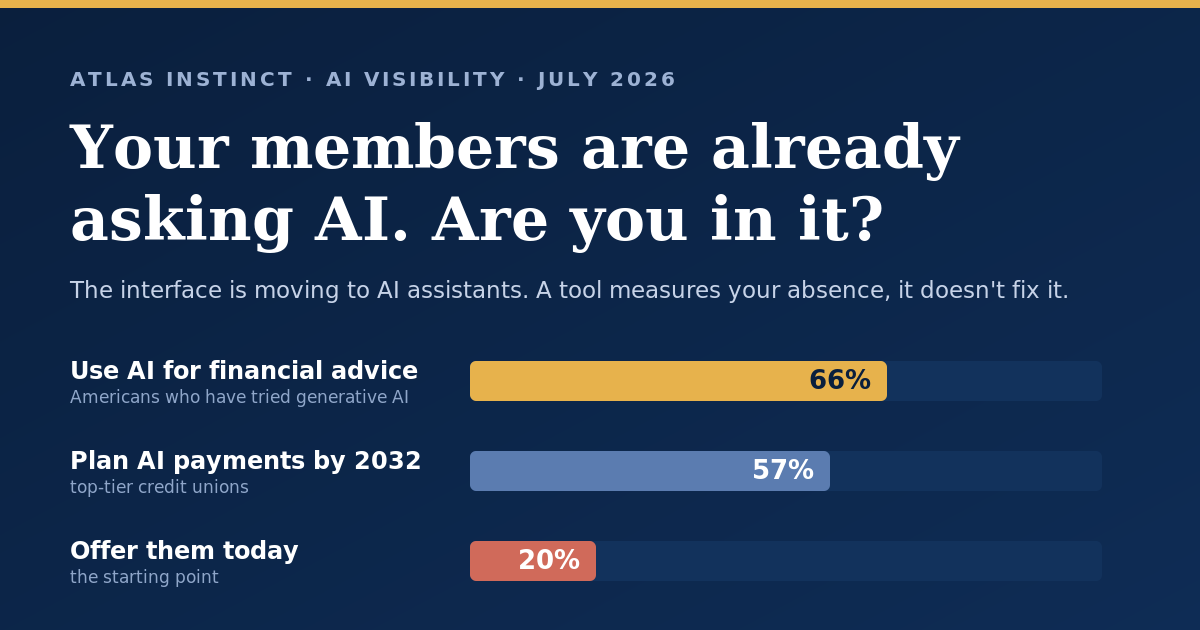
This is not a distant scenario. Two-thirds of Americans who have used generative AI have already used it for financial advice, per an Intuit Credit Karma survey cited by CNBC, July 7, 2026. So the demand is here, the interface is arriving, and the question for any credit union or fintech becomes simple. When the assistant answers a rate or product question, does it cite you, or does it cite someone else?
Your members will not see a page of ten blue links where you sit at position four. They will see one answer. Being absent from that answer is a different kind of invisible than ranking low on Google.
The audit-tool category is crowding fast
The vendors have noticed. Ahrefs released a Gemini-powered index that tracks links appearing in Google AI Overviews and AI Mode, plus a Brand Radar widget charting AI Overview mentions over time, according to the Ahrefs changelog, July 14, 2026. Two days later, a Lee Enterprises agency called Amplified Digital shipped an AI Visibility audit measuring brand presence across ChatGPT, Google AI Overviews, Perplexity, Gemini, and Claude, according to GlobeNewswire, July 16, 2026.
We read this as validation, not noise. When a traditional marketing services firm builds an audit product, the question "are we visible to AI models?" has moved from niche to mainstream. That is genuinely good for the category. But it also sets a trap. A crowded shelf of tools can make buying one feel like progress. It is not. A measurement is not a change. We have watched teams purchase a dashboard, confirm they are invisible, and then sit exactly where they started because nobody did the structural work the dashboard was pointing at.
Where the money is actually going
The pressure to keep pace is real and it is measurable. Credit unions expect to nearly triple their AI-enabled payment services. According to PYMNTS Intelligence and Velera, July 16, 2026, 57% of top-tier credit unions expect to offer AI-enabled payments by 2032, up from 20% today. That is capital and internal consensus moving in one direction over six years.
Here is the connection that does not get made often enough. If your own institution is planning to offer AI-driven services, your visibility to those same AI models stops being a marketing nicety. It becomes part of the product. And visibility is scarce even at the top. Only 36 global brands hold top-100 visibility across all four major AI platforms at once, according to the Semrush AI Visibility Index, June 26, 2026. Semrush is owned by Adobe and this is a vendor-published index, so read it as directional rather than neutral. Even discounted, the signal is stark. If enormous budgets do not guarantee cross-engine visibility, brand recognition offline buys you nothing here.
The fix is not more content. It is structure and specificity: crawlable rates, exact product names, clear terms, and machine-readable data an assistant can quote without guessing. That is the upstream work an audit points to but cannot perform for you. It is also the work we spend most of our time on. Our monthly benchmark of the sector, the Atlas Instinct AI Visibility Index, exists to show where institutions stand and, more usefully, what separates the cited from the invisible.
Frequently asked
Does buying an AI-visibility audit tool improve my visibility?
No. An audit measures your current position across engines. Improvement comes from the changes you make afterward, mostly to site structure and the specificity of your published rates, products, and terms. A tool that only reports and never prompts action will leave you exactly where you were.
How is this different from ordinary SEO?
SEO optimizes for a ranked list of links a person chooses from. AI assistants return a single synthesized answer and cite a handful of sources. Visa's assistant, entering US pilot in August 2026 per Yahoo Finance, July 14, 2026, is that model arriving inside banking apps. You are competing to be the cited source, not to place on page one.
We are a smaller institution. Is cross-engine visibility even realistic for us?
Yes, and in some ways more so. Only 36 global brands clear top-100 visibility on all four platforms at once, according to the Semrush AI Visibility Index, June 26, 2026, which tells you budget is not the deciding factor. Specific, well-structured content on a focused set of products often outperforms a large brand with vague pages.
How often should we check?
Quarterly, at least. Citation behavior is unstable enough that a single snapshot ages quickly, and multi-engine tracking is now built into mainstream tools like the Ahrefs update reported July 14, 2026. A once-a-year look will miss most of what changes.
Start a conversation
If the interface layer is moving and you are not sure whether AI assistants can cite you, that is the exact gap worth closing before the Visa pilot and its peers reach your members. We can run a snapshot of where your institution stands across the major engines and show you the structural fixes that would move the number. Start a conversation with Atlas Instinct and we will take it from there.